


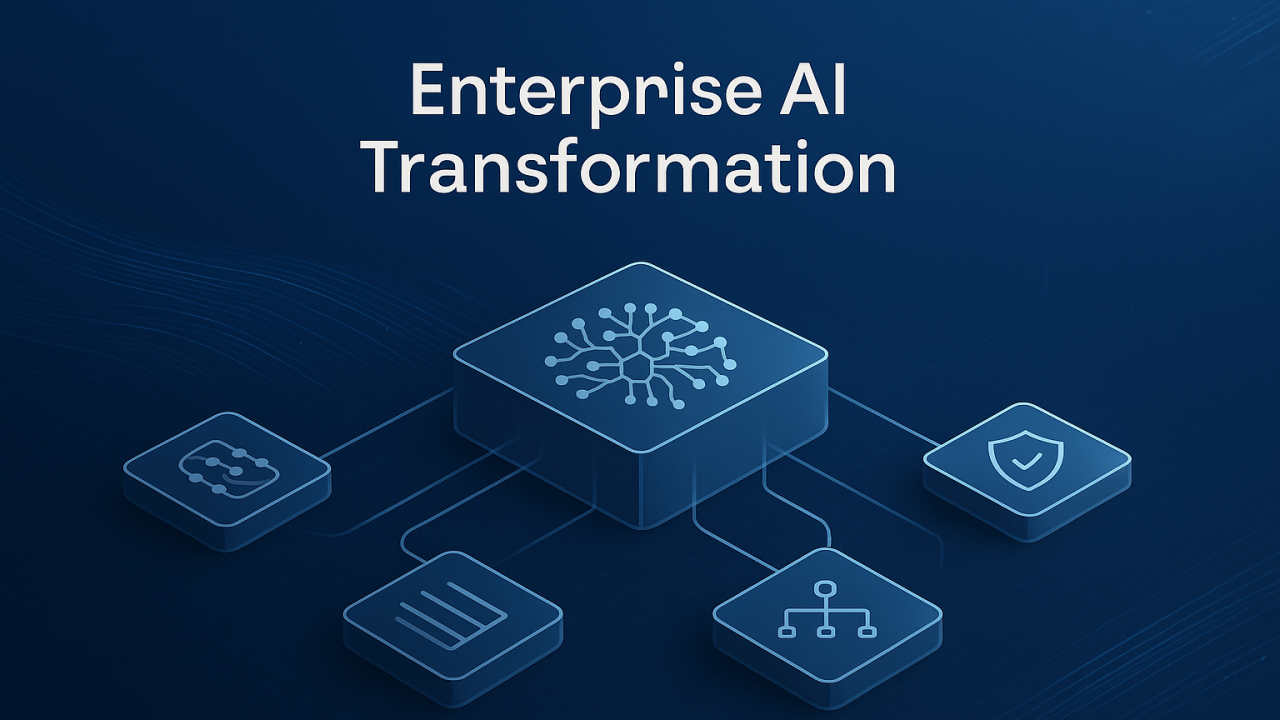
Artificial intelligence is moving faster than most enterprises expected. Just two years ago, your leadership team was likely exploring chatbots, content generators, and copilots. Today, the conversation has shifted toward systems that do not just generate responses but actually take action. This shift marks the evolution from generative AI to agentic AI solutions, and it is redefining how enterprises operate, compete, and grow.
If you are leading digital transformation in the United States, this transition is not optional. It is strategic. Analysts predict that by 2027, more than 60 percent of enterprise AI deployments will include autonomous or semi autonomous agents capable of decision making within defined guardrails. The companies that move early will shape the competitive landscape.
Understanding the First Wave: Generative AI in Enterprises
Generative AI changed how you create content, analyze data, and interact with systems. Tools powered by large language models helped marketing teams draft campaigns in minutes. Developers used AI to write code 40 percent faster. Customer service teams deployed AI chat interfaces that reduced response times by up to 35 percent.
Generative AI was powerful, but it had limitations. It primarily responded to prompts. It generated text, images, or code, but it did not independently execute workflows. It assisted humans rather than operating with autonomy. For many enterprises, this meant efficiency gains but not true transformation.
The Rise of Agentic AI Solutions
Now we are entering the era of agentic AI solutions for enterprises. These systems are designed to perceive, reason, decide, and act. Instead of waiting for a prompt, an agentic system can monitor signals, trigger workflows, collaborate with other systems, and continuously optimize outcomes.
Think of it this way. Generative AI gives you answers. Agentic AI gives you outcomes. An agent can detect a drop in customer engagement, analyze behavioral data, design a retention campaign, launch it, and measure performance with minimal human intervention. That is a fundamental shift.
Why Enterprises in the USA Are Accelerating Adoption
American enterprises are under intense competitive pressure. Labor costs are rising. Customer expectations are higher than ever. According to recent industry surveys, over 70 percent of US CIOs plan to increase AI budgets in the next fiscal year, with a growing portion allocated to agentic AI services & solutions.
You are not just looking for automation. You want resilience, scalability, and speed. Agentic AI allows you to scale decision making across departments without increasing headcount at the same rate. That is why sectors like finance, healthcare, retail, and manufacturing are actively piloting agent driven workflows.
From Assistance to Autonomy: The Core Difference
The core difference between generative AI and agentic AI lies in autonomy. Generative AI responds. Agentic AI initiates. It operates within defined objectives, constraints, and governance frameworks.
For example, in supply chain operations, an agentic system can monitor inventory levels in real time, predict shortages, negotiate with suppliers through automated systems, and adjust procurement schedules. Instead of waiting for your operations manager to intervene, the system proactively solves problems.
This shift from reactive support to proactive execution is what makes agentic AI solutions transformative.
The Role of Agentic AI Data Solutions
Behind every effective AI agent is a strong data backbone. Agentic AI data solutions ensure that agents have access to high quality, governed, and real time data streams. Without reliable data, autonomy becomes risky.
In modern enterprises, data is often siloed across CRM systems, ERP platforms, marketing tools, and cloud warehouses. Agentic AI integrates these sources, enabling contextual decision making. In fact, companies with mature data integration strategies report up to 50 percent faster AI deployment cycles.
If you want agentic systems to perform well, you must prioritize data architecture and governance.
Agentic AI for Localization and Global Reach
For US based enterprises expanding globally, agentic AI for localization is a powerful capability. Instead of manually adapting content, pricing, and customer engagement strategies for each market, agentic systems can dynamically localize messaging, adjust campaigns based on regional behavior, and ensure compliance with local regulations.
Imagine launching a product across multiple states or countries. An agentic system can analyze local trends, optimize messaging tone, adjust offers, and continuously refine performance. This level of adaptability increases conversion rates and strengthens brand relevance.
Enterprise Architecture for Agentic AI
To support agentic AI, your architecture must evolve. Traditional monolithic systems struggle to support autonomous agents. Modern architectures rely on APIs, microservices, cloud infrastructure, and event driven pipelines.
A typical enterprise agentic stack includes data ingestion layers, model orchestration frameworks, decision engines, workflow automation tools, and monitoring dashboards. Security and access controls are embedded at every level. This architecture ensures that agents operate within defined guardrails and compliance requirements.
When you design your system correctly, you reduce risk while maximizing innovation.
Governance and Risk Management in the Agentic Era
Autonomy introduces new governance challenges. Enterprises must define boundaries for decision making. What actions can an agent take independently. What requires human approval. How are audit trails maintained.
In highly regulated industries such as banking and healthcare, compliance is critical. Transparent logging, explainability mechanisms, and policy based controls ensure that agentic AI solutions for enterprises remain trustworthy. Research indicates that organizations with formal AI governance frameworks are 45 percent more likely to scale AI successfully.
Trust is not optional. It is foundational.
Measuring ROI from Agentic AI Investments
Executives often ask a simple question. What is the return on investment. The answer depends on how strategically you deploy agentic systems. When implemented effectively, enterprises report productivity gains of 20 to 30 percent in targeted workflows.
ROI comes from reduced manual intervention, faster cycle times, improved decision accuracy, and enhanced customer satisfaction. Over time, these improvements compound. A single agent that optimizes procurement or customer retention can generate millions in annual savings for large enterprises.
Your goal should not be experimentation alone. It should be measurable impact.
The Cultural Shift Required for Success
Technology alone will not drive transformation. Your teams must adapt. Employees need to understand how to collaborate with autonomous systems. Leaders must redefine roles and responsibilities.
When you introduce agentic AI, communicate clearly about its purpose. Position it as augmentation rather than replacement. Upskill your workforce to manage, supervise, and optimize agents. Enterprises that invest in training alongside technology adoption see significantly higher acceptance rates and performance gains.
Culture amplifies technology.
The Road Ahead: A Strategic Imperative
The evolution from generative AI to agentic AI is not just a technological upgrade. It is a strategic inflection point. You are moving from tools that assist humans to systems that act with delegated authority. This shift redefines productivity, scalability, and competitive advantage.
Enterprises that embrace agentic AI solutions, strengthen their data foundations, invest in governance, and prepare their workforce will lead the next decade of innovation. Those that hesitate may find themselves reacting rather than shaping the future. As you evaluate your AI roadmap, consider where you stand in this evolution. The move toward autonomy is already underway. The real question is how quickly you are ready to lead it.
